
GLOW Stack vs. Individual Peptides: What the Research Actually Shows
A combined peptide blend has not been shown to outperform its individual components, so the honest verdict is that the research doesn’t yet support choosing the stack version on results alone. Published studies examine peptides like GHK-Cu and others one at a time, and no controlled research tests whether blending them produces a better outcome than using them separately. What a blend does offer is convenience: one product, one protocol, fewer decisions.
That’s the same logic we apply when comparing solar equipment. Pairing a panel with a battery and an inverter can simplify an install, but only measured performance tells you whether the bundle beats the parts. Here, the measurements are thin, and it’s worth knowing that before you spend anything.
This comparison is for readers weighing the stack version against buying components individually. People in this position usually want the same things: a clear sense of what each option contains, what the evidence actually covers, and what it costs to find out. Below, we compare them dimension by dimension, separating what has been studied from what is assumed, so you can decide based on facts rather than marketing.
GLOW Stack vs. Individual Peptides at a Glance
The short version: a “GLOW stack” is a blended product that combines several research peptides, while individual peptides are the single compounds that most published studies actually examine. The comparison below shows where the two approaches stand on the points that matter most.
| Dimension | GLOW Stack (blend) | Individual Peptides |
|---|---|---|
| Composition | Multiple compounds combined in one product, with ratios that vary by seller | One defined compound at a time |
| Primary research focus | Little direct study of the blend itself | Mechanisms of single compounds, such as tissue repair signaling |
| Type of evidence | Mostly extrapolated from its components | Mainly cell and animal studies, with limited human data |
| Regulatory status | Not approved for human use in the US | Not approved for human use in the US |
| Interaction data | Not established in published research | Not applicable, since only one variable is tested |
| Quality-control transparency | Often unclear, especially on dose and purity | Varies, but easier to verify by compound |
The key unknown is interaction effects. When compounds are combined, researchers cannot assume each one behaves as it does alone, and no rigorous human trial has tested the blend against its parts. That is why claims of superiority for the stack remain unsupported. The evidence base belongs to the single compounds, and it is still largely preclinical. This is general education, not medical advice, so any decisions about peptide products belong with a licensed physician.
What Each Option Is: The Blend and Its Components

How Individual Peptides Are Studied
Most of what we know about individual peptides comes from laboratory and animal work, not from people. The usual progression runs from in vitro studies on isolated cells, to in vivo studies in rodents, and only rarely to small human trials. Each step tells researchers something different, and each has limits that are easy to overlook.
A few terms help make sense of the literature:
- Peptide
- A short chain of amino acids, the building blocks of proteins, that can act as a signaling molecule in the body.
- Preclinical research
- Studies done in cells or animals before any human testing, used to explore mechanisms and early safety signals.
- In vitro vs. in vivo
- In vitro means experiments in dishes or test tubes, while in vivo means experiments in living organisms.
- Certificate of analysis
- A lab document reporting a product’s identity and purity, ideally from an independent third-party lab.
Extrapolating from these studies to people is risky. Rodents metabolize compounds differently, doses are often scaled in ways that don’t translate, and a result in cultured cells may never appear in a living body. Single-compound studies are still valuable because they isolate one variable, but they describe that compound alone, not a blend.
How a Blended Stack Differs
When compounds are combined, the research picture changes in ways that are easy to overlook. A blend is not simply the sum of its parts. Each ingredient may behave differently alongside others, since compounds can compete for the same receptors, alter how quickly one another is absorbed or broken down, or influence the same pathways in ways no single-compound study would reveal.
Ratios matter too. Published studies on individual peptides use specific, documented doses. A commercial stack usually fixes its own proportions, often undisclosed or based on no trial at all, so the dose of any one component may bear little resemblance to what was actually studied.
This is why a blend cannot borrow the evidence of its components. Findings about compound A, tested alone, say nothing certain about compound A mixed with B and C at an unknown ratio. Until someone tests the combination directly, any claim about the stack as a whole is an assumption rather than a research result.
GLOW Stack vs. Individual Peptides, Dimension by Dimension
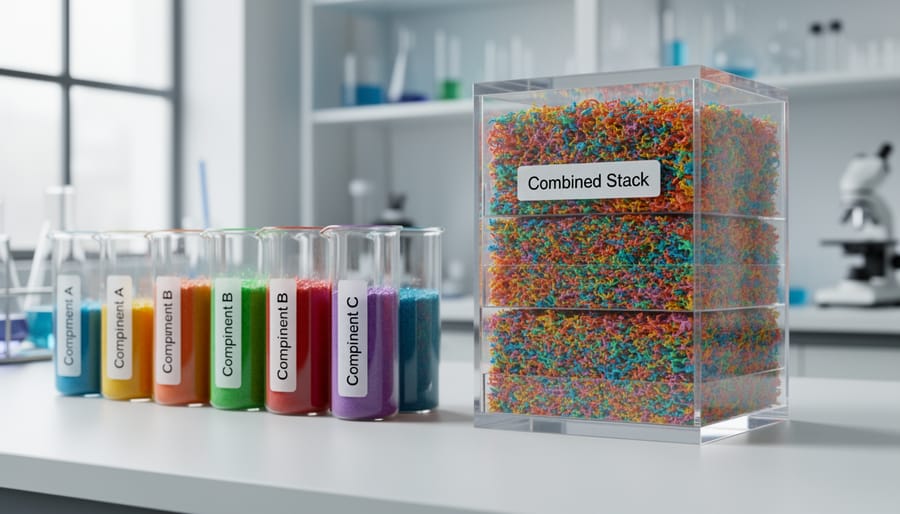
Evidence Quality and Attributing Results
Good research changes one thing at a time. When a study tests a single compound against a control, any difference in outcome can be traced to that compound. Scientists call this isolating the variable, and it is the reason single-peptide studies, even preclinical ones, are interpretable at all.
A blend scrambles that logic. If a stack of several peptides is tested and a result appears, you can’t say which ingredient produced it, whether two ingredients interacted, or whether any of them mattered. A cancelled-out effect is just as hard to read as a positive one.
Solar installers face the same problem. If a system’s output rises after someone swaps the inverter, adds panels, and trims a tree in the same week, nobody can credit the gain to any one change. Clean attribution needs clean testing, and a bundled product hasn’t had it.
Sourcing, Purity, and Regulatory Reality
Peptide products sold for research purposes sit outside the quality-control system that governs approved medicines. Because they are not FDA-approved for human use, no regulator verifies that a vial contains what the label claims, in the amount stated, free of contaminants. Independent analyses of products sold online have repeatedly found mismatched concentrations, degraded compounds, and impurities, and a blend multiplies the problem, since every added ingredient is another variable to get wrong.
Third-party testing is the closest thing to a safeguard. A credible supplier publishes batch-specific certificates of analysis from an independent laboratory, showing identity, purity, and potency for each component. A certificate that is generic, undated, or issued by the seller itself tells you little.
Regulatory status matters too. Compounds in these stacks have not completed the clinical trials needed for approval, and some face active FDA restrictions on compounding. A licensed physician can explain where any specific compound currently stands.
A Familiar Parallel: Testing Components vs. Marketed Bundles in Solar

A bundled solar package works the same way a blended peptide product does: the headline claim is only as trustworthy as the evidence behind each piece and the system as a whole. A brochure promising “maximum savings” means little unless every panel, inverter, and mounting component carries a rated, certified performance number, and unless the finished installation has documented output to match. A reputable installer, Solar Concepts included, builds around certified equipment and records what the system actually produces, so you can check the claim against real data.
That is why we encourage homeowners to pick the right company by asking for proof instead of promises. It also helps to understand the technical requirements of a successful installation, so you know which numbers to request and what they should look like.
Consider a Scottsdale homeowner who told us she wouldn’t sign anything until she’d seen certified equipment specifications and production records from comparable systems. Her reasoning was simple: a bundle can look impressive while hiding weak parts. Once she could trace each component to a tested rating, she moved forward with confidence.
The same discipline applies to the research question in this article. Evidence for the parts doesn’t automatically transfer to the bundle, and a claim about the whole deserves its own verification.
Which Approach Should You Trust? Choosing Based on Evidence and Your Situation
Your goal shapes the right approach, so start there. The evidence is uneven, and the best choice depends on what you’re actually trying to do.
- If you want to understand the science, follow the single-compound research, where the studies actually exist.
- If you’re evaluating a specific product, treat any claim that a blend outperforms its parts as unproven.
- If you’re thinking about using one, talk with a licensed physician before anything else.
- If you’re comparing sources, favor those that cite named studies and say plainly what hasn’t been tested.
Marketing is where most readers get misled, so know the red flags. Be wary of language promising dramatic results, “clinically proven” labels with no study attached, and testimonials standing in for data. Vague ingredient ratios are another warning sign. If a seller can’t tell you exactly how much of each compound is in the blend, you can’t evaluate it, and neither can a doctor. The same goes for any pitch that blurs the line between preclinical findings and human outcomes.
If you do consult a clinician, bring specific questions. Ask what human evidence exists for each component individually. Ask whether anyone has tested the combination at all. Find out how the product is sourced and whether independent labs have verified its purity and dose. And ask what risks apply to your own health history.
It’s the same discipline we’d urge when reviewing solar equipment: tested, documented performance should outweigh a confident sales pitch. A good provider welcomes those questions, and a good source answers them without hedging or hype.
Common Questions About GLOW Stack and Individual Peptide Research
Readers tend to ask the same handful of questions about this topic, so here are direct, cautious answers based on what the published research does and does not show.
Is a stack better than single peptides?
There is no rigorous evidence that it is. The published work studies individual compounds, so claims that a blend outperforms its parts are not supported by current research.
Is a GLOW-type stack legal or FDA-approved?
These compounds are not approved by the FDA for human use in the US, and products sold online often fall into a regulatory gray area. Availability is not the same as approval or proof of safety.
Are there human trials comparing a stack to its components?
No well-controlled human trials directly compare a blended stack to its individual ingredients. Most of the existing literature is preclinical, meaning cell or animal studies.
What are the risks?
Risks include unknown interaction effects, unclear dosing, and inconsistent purity in unregulated products. Anyone considering a peptide product should talk with a licensed physician first.
Judging a source’s quality comes down to a few habits. Look for peer-reviewed studies, check whether the work was done in humans or animals, and be wary of marketing that cites no data at all. Ask for third-party purity testing, and notice whether the claims match what the studies actually measured.
The same skepticism serves you well elsewhere. If you’re weighing a major purchase like solar, our solar panel FAQs show how verified, documented answers beat confident but unsupported claims.
The research base for peptides sits with individual compounds, and most of it is preclinical. Whether a blended stack like GLOW adds anything beyond what its components do alone remains unproven, because no rigorous human trials have tested the combination against its parts. Until that evidence exists, claims of superiority deserve healthy skepticism. This article is general education, not health advice, and any decision about these compounds belongs in a conversation with a licensed physician.
The lesson reaches well beyond peptides. Whether you’re weighing a research claim or a major purchase, the same habit pays off: ask what was tested, by whom, and under what conditions, then favor sources that show their work. Transparent, verified performance data is the difference between a promise and a result.
That standard is exactly how we approach solar at Solar Concepts. Every system we design relies on rated, certified equipment and documented output, so you can see what your investment should produce before you commit. If you’re an Arizona homeowner or business owner considering solar, contact us to talk through the numbers and explore a solution you can verify for yourself.
Key Takeaway
Treat this article as general education rather than guidance for your own health. Whether you are weighing research claims or a solar investment, the same habit serves you well: trust what has been tested, documented, and verified.